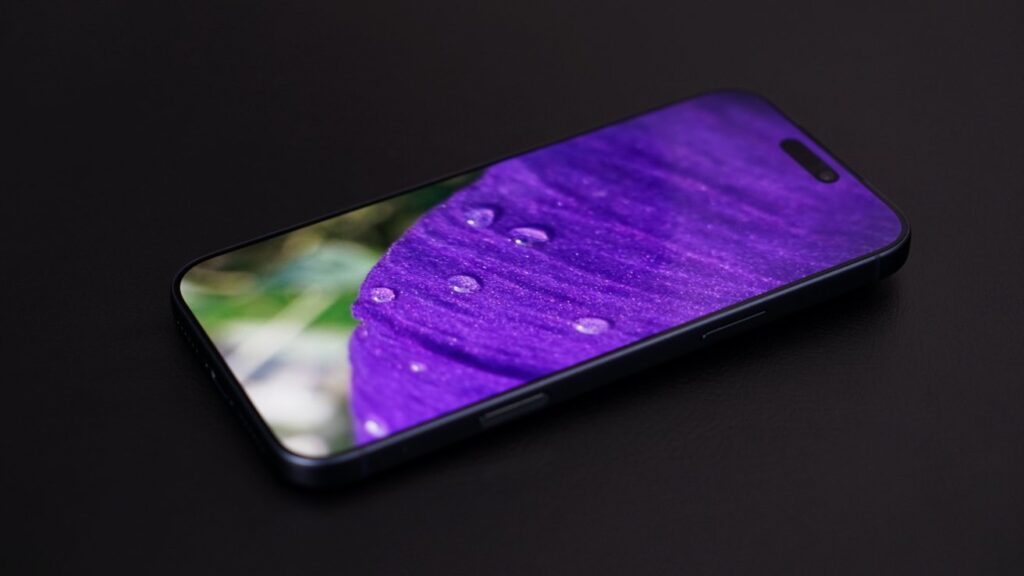
Apple’s suppliers are working on a new OLED manufacturing technology that could provide brighter displays for iPhones and iPads.
Apple has long been planning to replace the displays of all its products with OLED. While it’s on track to achieve this goal, the OLED panels it uses in the future could be a marked improvement over the ones in use now.
Second The Elect on November 3, Apple display suppliers Samsung Display and LG Display are working on new methods of making OLED screens. Both are suppliers in Apple’s OLED supply chain and are keen to secure more orders from the company.
A source says Apple is prioritizing the use of an existing sputtering process to create panels based on High Mobility Oxide (HMO). Both Samsung and LG are creating new atomic layer deposition (ALD) and sputtering methods that can be used on production lines.
There are some benefits to the changes, including brighter individual pixels on the panel. This can increase not only the brightness but also affect the contrast of the screens.
The research could also slightly reduce the cost per display, making it more suitable for use on budget products.
HMO, ALD and Sputtering
HMO refers to a process that makes the thin-film transistor (TFT) used to turn a pixel on and off better. As the “High Mobility” part of the name indicates, the electrons in that circuit move three to five times faster than normal.
This helps create high refresh rate displays, which are necessary for features like ProMotion.
Both Sputtering and ALD refer to deposition technologies, or the way OLED material is applied to the thin film substrate.
Sputtering relies on plasma to detach atoms from a material and deposit them onto the substrate. It’s a useful technology, as it can use equipment already in use on OLED production lines, so there’s no need to acquire more specialized hardware.
The MacBook Pro PROLED apparently uses HMO, but sputtering and ALD could lead to an even better display – Image credit: Apple
ALD uses gaseous materials, which are then applied directly to the layer. This is a highly controllable process since the thickness of the layer can be precisely managed and thus define the electrical characteristics of the layer.
However, unlike sputtering, ALD requires high-cost machinery and raw materials. This precision comes at a considerable cost.
As a result, both Samsung Display and LG are prioritizing sputtering development, while also researching ALD in the background, a source says.
The future is now
While the report is about display vendors researching and developing the technology, it may already be here.
According to Ross Young, consultant at RDL and former CEO of DSCC, the new PROLED MacBook Pro already uses HMO for its display. It does not use existing LTPS or LTPO technologies for its backplane.
Panel manufacturing is supposedly done on Samsung’s A6 fab, which is the first in the industry to produce displays with HMO. Young adds that the panels are made using a much larger substrate than current LTPO and LTPS production lines.
While the display is interesting for HMO use, it is not one that uses sputtering nor ALD. When one of these is approved and adopted by Apple, it could become even better than the MacBook Pro’s PROLED screen.