No spacecraft has ever successfully brought a sample of Mars back to Earth. China intends to be the first, with a mission called Tianwen-3 aiming for a 2031 return date — right as NASA’s own long-running effort to do the same thing has stalled out under budget pressure and reported cancellation. The result is a genuinely open race for one of the biggest remaining milestones in planetary science.
China’s 2031 Target: The Mission Behind the Date
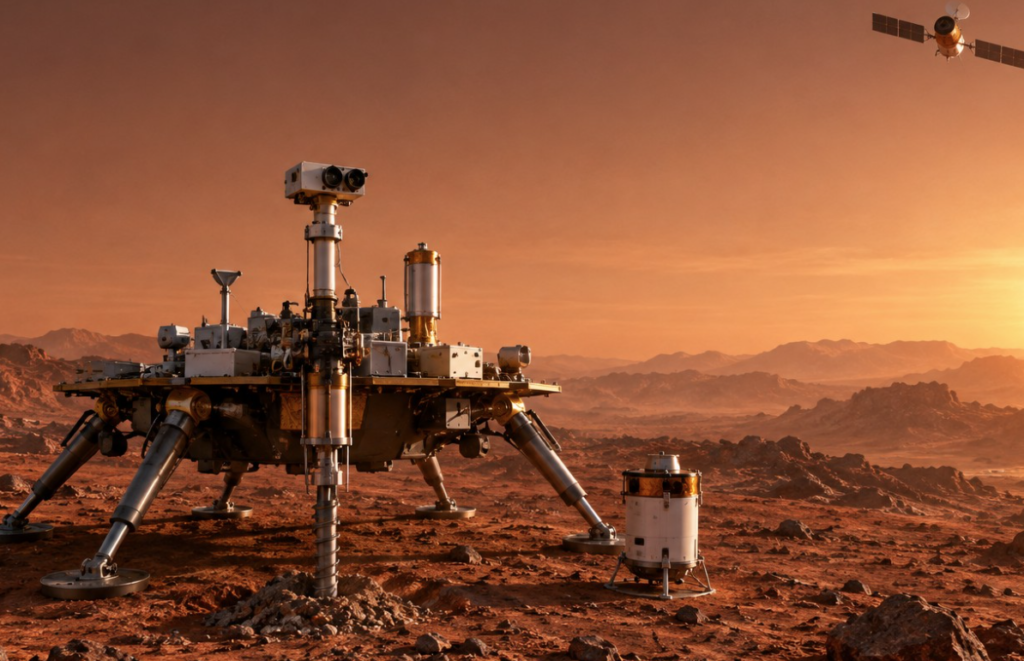
Tianwen-3 is China’s answer to a decades-old scientific goal: physically retrieving Martian rock and soil and getting it back to laboratories on Earth. The mission, run by the China National Space Administration, is built around five separate spacecraft components working together — a lander with a built-in drill and helicopter scout, an ascent vehicle, a service capsule, an orbiter, and a reentry module for the final trip home. The plan calls for collecting at least 500 grams of material directly at the landing site, launching it into Mars orbit aboard the ascent vehicle, and docking with the orbiter for the journey back to Earth.
Why NASA’s Own Sample-Return Effort Is in Trouble
NASA isn’t starting from scratch on this front — its Perseverance rover has already spent more than four years collecting and caching samples on the Martian surface specifically for later retrieval. The problem is the retrieval half of that plan. NASA’s Mars Sample Return program, developed jointly with the European Space Agency and approved back in 2022, has been repeatedly reworked, delayed, and cut down amid mounting budget pressure, and reporting indicates the program was cancelled outright in 2026. That leaves NASA with a rover full of carefully selected samples on Mars and no clearly funded plan to bring any of them home.
Two Very Different Strategies for Getting Samples Home
The contrast between the two approaches goes beyond just timing. NASA’s plan was built around scientific selectivity — Perseverance spent years carefully choosing which rock cores to collect from Jezero Crater, a site picked specifically because its ancient river delta geology offers strong odds of preserving evidence of past microbial life. Tianwen-3 is taking the opposite approach, prioritizing mission safety and schedule certainty over site complexity. Chinese mission planners reviewed 86 potential landing zones and selected one that’s comparatively flat and straightforward to land on, trading geological richness for a substantially lower-risk touchdown.
The Launch Window That Leaves No Room for Delay
Because Earth and Mars only align favorably for a direct transfer roughly every 26 months, Tianwen-3 has a narrow launch window running from December 2028 into January 2029 — and missing it would push the entire mission, along with its 2031 return date, back by more than two years. The mission will fly on two Long March 5 rockets launching from the Wenchang Space Launch Site, the same heavy-lift rocket family that powered China’s successful Chang’e-5 and Chang’e-6 lunar sample-return missions.
What China Already Has Working in Its Favor
Skepticism about an ambitious Mars timeline is fair, but China’s recent record lends real credibility to the plan. Its Zhurong rover successfully landed on Mars’s Utopia Planitia in May 2021 as part of the Tianwen-1 mission, proving China’s ability to pull off a complex interplanetary landing on its first serious attempt. On top of that, China has already executed two successful lunar sample-return missions, Chang’e-5 and Chang’e-6, giving its engineers direct, tested experience with exactly the kind of ascent-and-rendezvous architecture Tianwen-3 depends on.
The Scientific Catch: Not All Samples Are Equal
Even a successful, on-schedule Tianwen-3 landing wouldn’t necessarily settle the deeper scientific competition. Perseverance’s cached samples were selected through a meticulous, multi-year process specifically aimed at maximizing the odds of detecting signs of ancient life. Tianwen-3’s samples will come from a site chosen mainly for its safety profile rather than its geological interest. Being the first country to physically return Martian material to Earth and being the first to make a major scientific discovery from that material are two different milestones — and there’s no guarantee one automatically leads to the other.
A Door Left Open for International Scientists
One detail that cuts against the purely competitive framing of this story: China has set aside real payload capacity on Tianwen-3 for outside researchers, roughly 15 kilograms on the Earth-return spacecraft and 5 kilograms on the orbiter for international science instruments. Proposals were accepted through mid-2025, selections were finalized later that year, and participating hardware is due for delivery in 2027. That openness suggests China is positioning the mission, at least partly, as a shared scientific opportunity rather than purely a national prestige project.
What Experts Are Saying About Who Wins
The tone among space policy observers has shifted noticeably in recent months. Where NASA’s mission was once treated as the presumptive frontrunner simply because Perseverance already had a head start on the ground, experts are now openly acknowledging that China could realistically get there first. One planetary scientist summed it up bluntly, warning that China may well beat the US to a Mars grab sample. With NASA’s program reportedly cancelled and no clear, funded alternative on the table, some researchers are now arguing that returning Mars material ahead of China deserves to be treated as a genuine national priority rather than a secondary science objective.