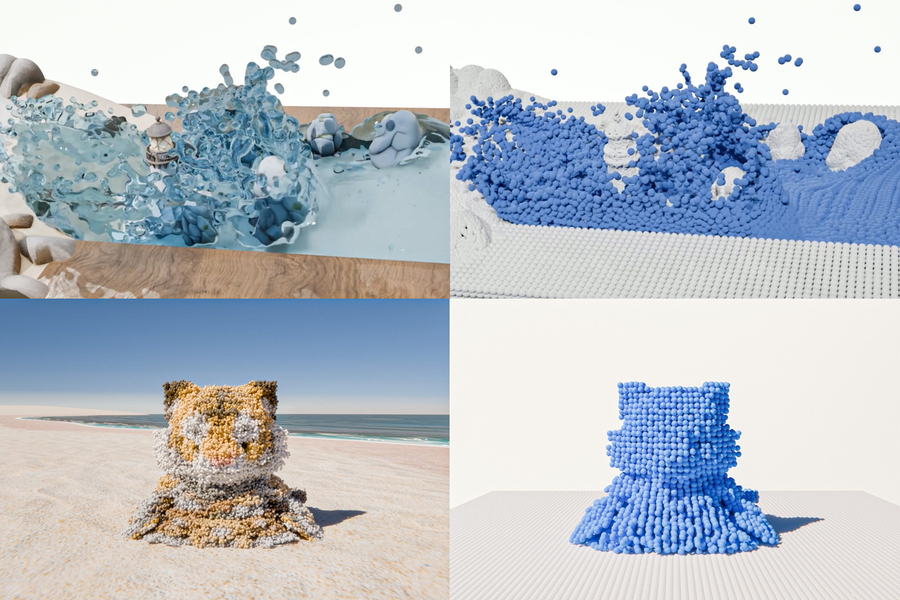
However, MIT has now developed an artificial intelligence system capable of simulating a wide range of materials and their physical behavior. MIT calls the program WorldParticle. Instead of modeling each material using its own physical equations and a custom-coded simulation method, AI breaks down different objects into large numbers of tiny three-dimensional particles.
Each particle has a spatial position, velocity, physical properties, and interactions with other particles and/or external forces. While ChatGPT, for example, predicts the next word, WorldParticle predicts the next state of particle motion.
So far, the model can already simulate six different physical phenomena: granular materials like sand or soil, liquids, deformable solids (like elastic objects), and even proteins (which model how molecular structures change over time). The simulation of protein movements, for example, is said to have been around 100 times faster than conventional methods used for comparison.