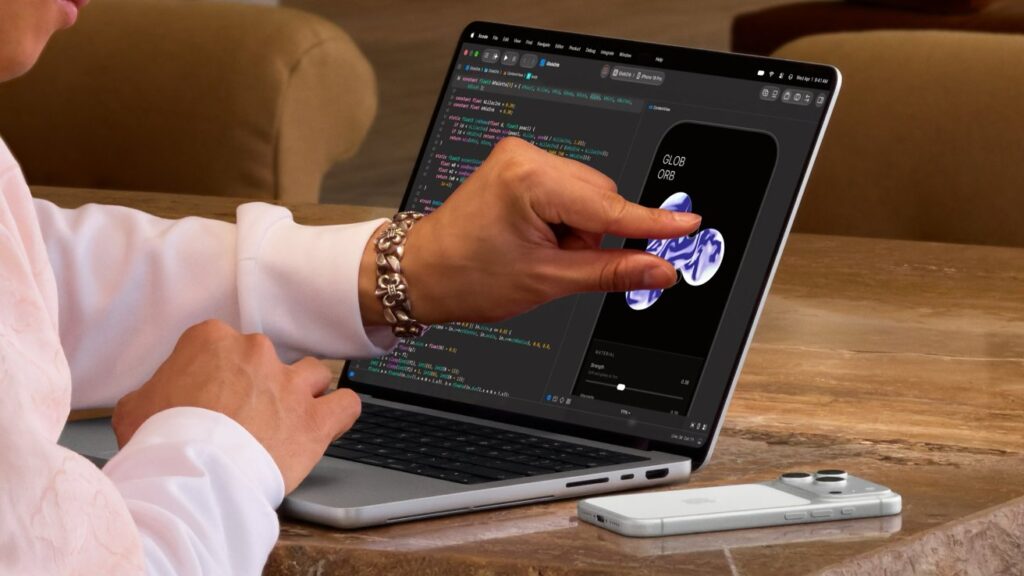
The new MacBook Pro uses pulse-width modulation which induces eye strain and headaches for some new buyers. Here’s what pulse width modulation is, why it might cause problems for some users, and what you can do about it.
In short, the MacBook Pro PROLED constantly flashes with a very bad combination of frequency and amplitude. It’s not as noticeable as a flashing light at a rave or party, or light filtered by the blades of a helicopter, but it happens constantly, at close range.
Some people are susceptible to potentially serious health problems from those strobe lights. Others may have health conditions already aggravated by flashing lights.
Video game publishers have been warning about this sort of thing for some time, and the concept has been used by trolls to attack people with epilepsy. The health concerns aren’t as bad as what the Apple Vision Pro can induce given the wide field of view filled by the headphones, but given that this is the first time the technology has come to the MacBook Pro, it’s worth talking about again.
Here’s why this matters and to whom it matters.
Health problems caused by strobe lights and who is affected by them
We are not doctors here at AppleInsiderbut this author had a son who was profoundly epileptic and we talked to neurologists before writing this article first for the Apple Vision Pro and now again for this version of the article for the MacBook Pro.
We feel comfortable writing this article given this mix of practical experience and professional advice.
There are three main types of health impacts from strobe lights: flicker dizziness, photosensitive epilepsy, and general photosensitivity.
Flicker Vertigo occurs at refresh rates between 1 Hz and 20 Hz and can cause disorientation, nausea, and rapid eye movements.
He was first spotted on early helicopters, watching the sun flash through the helicopter’s rotating blade. It is less common on the road, but can still be seen by the driver and passengers as the sun filters through the trees as a car passes through a lightly wooded area.
Flickering Dizziness is common, but fortunately the symptoms fade when the strobing stops. It’s not particularly relevant for MacBook Pro owners, unless they get hit with malicious content, which, as we mentioned, happens from time to time.
Photosensitive epilepsy is much less common, but much more dangerous. Although sensitivity varies, any stroboscopic effect can induce a seizure in people with photosensitive epilepsy. Individual circumstances and the severity of the crisis may vary from person to person.
And it is possible for someone to have no other outward signs of epilepsy and still be susceptible to specific photosensitive factors that they were previously unaware of.
Other health conditions can be aggravated by strobe light. A very high percentage of traumatic brain injury sufferers report photosensitivity, as do people who suffer from migraines, frequent tension headaches, or cluster headaches.
If you’ve ever been told you suffer from photophobia, the Apple Vision Pro and new MacBook Pro PROLED are probably not for you.
Sensitivity to strobe lights is also aggravated by fatigue of any kind, diet, length of exposure to strobe lights, and a host of other situations. If you are well rested, you may not be sensitive to strobe lights.
If you skipped a meal, slept all night in front of your MacBook Pro, and didn’t sleep the night before, this is the worst-case scenario.
In all these cases, the situation is exacerbated as more of the user’s field of vision is affected by strobing. In the case of the Apple Vision Pro, the user’s entire field of vision is covered by the pulse-width modulation strobe used to control the screens’ brightness and color mix.
For the new MacBook Pro, the field of view is not full, but it is wide. Pulse width modulation, which is not the same as the screen refresh rate, runs at 240 Hz on the new MacBook Pro, with a flicker amplitude of 56%. It’s the same as modern iPhones, but it’s also on a much larger screen.
For example, pulse width modulation also exists in non-OLED screens. The MacBook M4 Pro Mini-LED has a pulse width modulation of 14,880 Hz, which is better for almost everyone.
Clearly, not everyone is affected by strobe lights, and even so, frequency sensitivity can vary. This is good, considering that the LED bulbs that have replaced incandescent lights flicker, although less so than the fluorescent bulbs that formed a buffer between the Edison incandescent bulb and the newer LED.
But this is little comfort to those affected. And that’s why the Genius Bars we spoke to are receiving complaints and retailers are experiencing hardware returns at a slightly higher rate than normal.
Just because you don’t have a problem, doesn’t mean it isn’t a problem.
What is Pulse Width Modulation?
There’s a lot to be said about pulse-width modulation in electronics as a whole, but as far as Apple hardware goes, pulse-width modulation is what Apple uses by default to adjust the brightness of individual color cells in the eye’s displays.
An incandescent bulb that can dim emits fewer photons when it has a lower wattage, roughly proportional to the amount of power cut. Provide half the power to an incandescent bulb and its brightness will be about half as bright.
It does not turn off quickly and does not flash. Incandescent bulbs simply emit fewer photons due to lower wattage.
In an OLED display like the one used in the MacBook Pro, brightness control and color mixing are done by turning individual color cells on and off very quickly. If full power is consistently applied to a color cell, the cell is “on time” or has a 100% duty cycle and is fully bright.
Pulse Width Modulation and Duty Cycle Example – credit circuitdigest.com
While there is an overall screen refresh rate factor to consider regarding health, in short, given a fixed rate, to reduce brightness, at default settings, the color cell is turned on and off extremely quickly. A 50% duty cycle requires the cell to be on or off half the time and about half the brightness. It also effectively flashes the user at a different frequency than the display as a whole.
Pulse width modulation has been used in OLED iPhones since the iPhone It’s always been a concern on some level, for some people. However, the iPhone is a portable device, which does not occupy the large percentage of the field of view maintained by the Apple Vision Pro and PROLED MacBook Pro.
How serious is this?
We have been looking for reports of photosensitivity since the launch of the new iPad mini and MacBook Pro PROLED, as we did for the Apple Vision Pro. There are periodic reports on social media of headaches and tiredness.
The advice is clear from the doctors we spoke to and from Apple itself. If you start to feel strange in any way while using Apple Vision Pro and now MacBook Pro, stop using it and make an appointment with your doctor.
And watch for symptoms in people you care about who are new owners. It’s easy to get too excited about new technologies and use them for much more than you should in the beginning.
Apple has help for this on the iPhone, but not yet on the MacBook Pro.
There is no good way to reduce MacBook Pro strobing
There is a setting on iPad mini and iPhones after iPhone 17 called Display Pulse Smoothing. It’s found in Accessibility, and when the feature is on, it turns off pulse width modulation at lower brightness and uses voltage dimming to provide a different way of dimming the OLED display.
This setting is not in macOS. At least not yet.
As of November 10, 2026, if you know you are sensitive to pulse width modulation or strobing, do not buy the new MacBook Pro with PROLED display. Stay true to previous models.