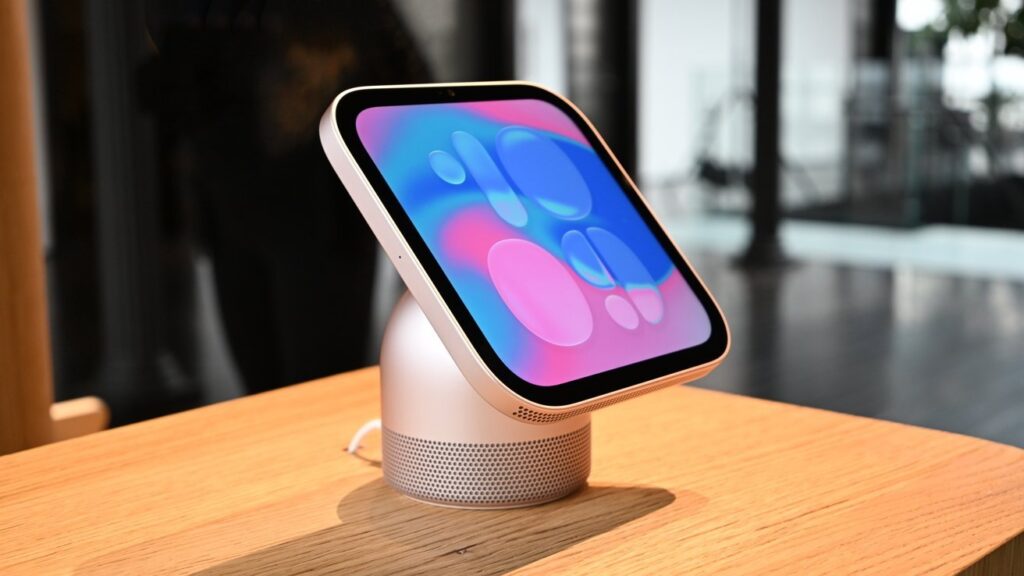
In this week’s Sunday Reboot, Apple’s HomeView is an interesting launch for the smart home, but it will likely work better in some countries than others.
Sunday Reboot is a weekly column covering some of the lighter stories in Apple’s reality-warping space from the past seven days. All to start next week with a good first step.
Truth about the smart home
Apple’s big smart home event was important in many ways. Sure, we expected the HomePod mini 2 and Apple TV 4K updates, but the launch of HomeView hit hard.
To be fair, Apple announcing a completely new product is a major event, but doing so in a completely new direction is a seismic event. Making a smart home management device is a big move for the company.
We can certainly understand the purpose of the device. It’s meant to be the center of your smart home and also a way to help you manage your life.
I’ll be honest. I didn’t expect much from HomeView.
Rumors said it would basically be a HomePod with a display, and that’s pretty much what we got. It’s a smart screen that very much reflects Apple’s ethos, in a market that has existed for a long time and has been dominated by Google Assistant and Amazon Alexa.
However, there are certainly some design choices that make me question how necessary the device really is.
For starters, it’s not an iPad on a fancy stand. Sure, it has a large touchscreen, but you’re sorely lacking in the kind of apps you can use with it.
This is not a general purpose device. It’s primarily intended to handle smart home stuff and not much else beyond that.
Of course, it will work with smart doorbells, so you can see who’s at the door stealing your Amazon deliveries. Sure, you can use it as a FaceTime station, just like the old “landline” families used before cell phones were a thing.
Playing music is also useful, but it’s strange that it’s a device that can handle video but you can’t install Netflix on it. It is claimed that users have enough devices to access this sort of thing, but the lack of an App Store seems strange.
This could always change in the future. But, for now, it’s a strange app existence centered around CarPlay, of all things.
It could be so complicated that some users might simply use an old iPad on a stand in their kitchen instead. This is an entirely possible thing to do with an older, unused model, but considering that Apple has pretty much prevented an iPad from being a home hub since iPadOS 16, you need a HomePod or Apple TV as a hub instead.
HomeView in its natural state
There’s also the pricing puzzle. For some reason, you’re paying $299 for the standard version with base and the same amount for the wall-mounted model, no base included.
Not only do you not get that base, which includes additional speaker components for fuller sound, but you have to pay even more for the stand.
It’s a strange case of paying more to get less.
Maybe I’m down because I know that Apple’s first-generation launches are baby steps for a trillion-dollar company. The walking device so that follow-up can be done.
The second version could be a much more useful device, if Apple plays its cards right.
Space, or the lack thereof
I was asked if I would buy HomeView and the answer unfortunately is no. Even if money wasn’t an obstacle, it’s a product that doesn’t quite fit into my current smart home existence.
It’s not because the ecosystem would reject it. I already have an Apple TV 4K, two HomePod minis, and a collection of smart plugs and lights that work in the Home app.
The real problem is the house itself. Or maybe the country.
I live in the UK, which is not known for huge houses. A 2019 survey of house sizes across England revealed that the average size of a home was 94 square metres, or 1,012 square feet.
In some parts of the world, there doesn’t seem to be much space, and you’d be right. In the United States, the average floor space is approximately 1,800 square feet.
The amount of space in your home determines many factors, including how many rooms it has and the size of those rooms. In the UK, this means you’ll find that homes have much smaller rooms in general than in the US.
In my case, the house I live in has a total floor plan of about 850 square feet of space to play with, across two floors.
This is a typical duplex with a living room, dining room and kitchen downstairs, with two reasonably sized bedrooms, a small bathroom and a “utility room” bedroom that can barely fit a full-sized single bed.
That’s a lot of rooms that fit into not a lot of space.
The English dream of having a large house, but the prospect of open-plan living exists only in the inevitable repetition of Friends.
This means HomeView will have a harder time selling in the UK than in the US.
A wall-mounted HomeView.
The design is very oriented towards homes with more space available. This house doesn’t provide that at all and we need to seriously consider what things we already have before adding something new to the mix.
Then there’s the issue of mounting it on the wall. Of course, in some families it is quite possible, but it will depend a lot on where it will be placed.
This house has a smart thermostat in the hallway, which I only physically interact with if I pass by it occasionally or if I need to change the batteries once a year. If I want the temperature to go up, I simply speak and hope that an iPhone, iPad, or HomePod can hear me and change the temperature for me.
It is an intelligent device with a display, to be placed in a high-traffic point of the house. However I would prefer to interact with it using the Home app rather than directly.
If I want to control things manually, or control the doorbell camera, or change the color of the lights, I can do it easily from the iPhone I always have in my pocket. I won’t get up to go to HomeView to do this, especially if I’m comfortable on the couch.
I fear HomeView would exist and have minimal real use if it were mounted this way in this house. I would be no better off than using an iPhone and Apple TV 4K as a hub, just like it is now.
For many reasons, HomeView is simply not viable in this particular household and would probably be an extravagance for most people in the UK too.
While I would wait for the release of the second device, which would usually fix the issues raised in the first, I might as well overlook it based on the current rumors.
I already miss the space as it is. Do I really need to include a robotic arm in the equation?
It’s not hard to imagine families across the United States enjoying the new robotic character, turning to face whoever is speaking at the moment like a lamp crossed with an excited golden retriever.
I just can’t think of the same thing working in the cramped conditions of typical UK housing.
Plus, the cats would have a blast.
Last week’s Sunday Reboot discussed the planned launch of the OLED touchscreen MacBook Pro and the pipe dream of macOS on an iPad Pro.