ⓘ NASA – Unsplash
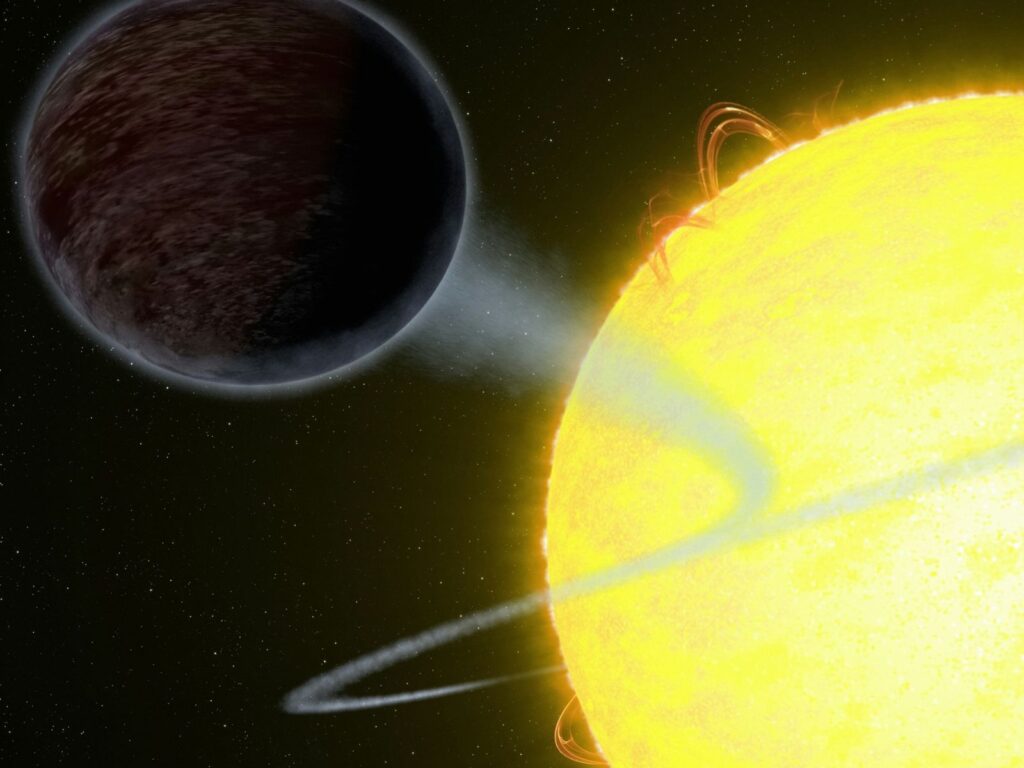
Brown dwarfs, also known as failed stars, are celestial objects with a mass between 13 and about 80 times that of Jupiter. They are called that because they are not massive enough to support hydrogen fusion in their cores. However, some brown dwarfs face a terrible fate, as in the case of the ZTF J0440+2325 system.
Located in the Milky Way, about 300 light-years from Earth, this system consists of a low-mass star and a brown dwarf. Initially detected by the Zwicky Transient Facility (ZTF), it was identified by Kevin Burdge when he noticed an unusual brightness variation that resembled a triangle in the ZTF data.
He initially thought this signal might be caused by a binary black widow, a neutron star devouring a companion star. To try to explain this phenomenon, he suggested that this variation could be caused by two celestial objects with similar masses.
Thanks to new observations, astronomers have determined that this system is composed of a brown dwarf and a star. Their respective masses are estimated to be 25 and 85 times that of Jupiter, respectively. Furthermore, the brown dwarf is believed to orbit its host star in just 86.65 minutes.
According to simulations, the star accumulates matter from the brown dwarf at a rate of about 1/100,000 of Earth’s mass per year. And that’s not all, because this phenomenon could last billions of years yet.
I have been working in the web writing field for several years and my passion is keeping readers updated on the latest news on astronomy, technology, the world of video games and other interesting topics. In particular, I have had the opportunity to work on numerous websites, which has allowed me to cover a wide range of topics. In my personal life, I am passionate about a wide range of topics, including astronomy, video games, history, and science. I am also drawn to psychology, which is a topic that deserves more documentation and recognition.