It’s been about six years since Apple Silicon hardware started shipping, and still Apple won’t release a Mac without pointing out how much better it would be if everyone switched from Intel, please.
It stands to reason that if you were an Intel Mac user and even tried the first M1 equivalent Apple Silicon, you might even be shocked by the It’s been six years since Apple Silicon was introduced and still Apple won’t launch a Mac without pointing out how much better it would be if everyone switched from Intel, please.. You definitely didn’t want to go back.
But you had to try it, you had to see the difference, and apparently enough people haven’t tried Apple Silicon that Apple continues to target them. It’s not altruism on Apple’s part, it’s not the company that wants to save users from what now really feel like the incredibly slow Macs of the past.
Instead, Apple may also face the problem of Apple Silicon users not looking at the new Apple Silicon Macs. It is not needed. The jump from Intel to M1 is huge, but from M1 to M2 is not.
Or from M2 to M3 and so on. It now takes a couple of generations before Apple Silicon Macs are worth upgrading.
This is in no way a criticism of the new Macs, it’s an acknowledgment of how good all Apple Silicon Macs are.
So Apple is fighting a two-front battle, trying to convince everyone and anyone to upgrade, whether they’re on Intel or the old Apple Silicon. As a result, its PR for the new iMac and MacBook Pro is full of phrases hoping to persuade naysayers.
“There has never been a better time for customers to upgrade from a previous-generation MacBook Pro with Apple silicon or an Intel-based Mac,” Apple says in the announcement of the new 14-inch MacBook Pro.
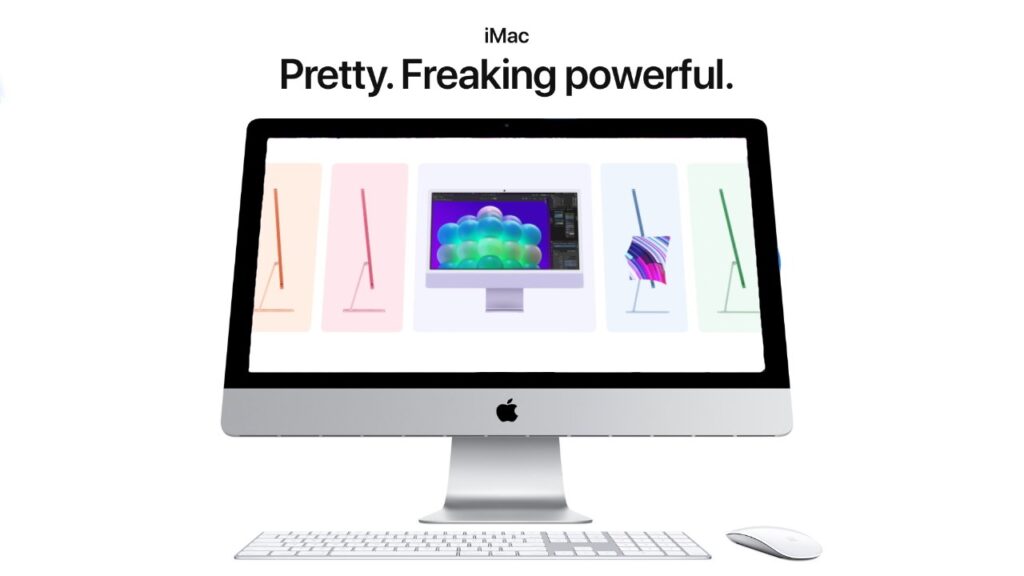
This 2020 iMac was the last to use an Intel processor.
Or “for Intel-based upgrades, the leap is even greater, with performance up to 18 times faster than the most popular Intel-based iMac,” reads the announcement for the iMac M6.
Checking the details
Let’s up the ante a bit and make some similar comparisons. One of Apple’s M6 launches is for the iMac, and in 2020 if you had a desktop Mac and read regularly AppleInsiderit was probably the then-current 27-inch iMac with i7, not i5, or equivalent.
To be clear, this can’t be a statistically flawless comparison given that the iMac was 27 inches and new Macs have 24-inch screens. Also, of course, the new models have not yet been tested.
However, it would be very strange if the performance of the 12-core iMac M6 was different from that of the current M6 Mac mini. And there are comparable Geekbench test scores for that Mac mini and the 2020 iMac, so the same tests were run on both types of machines.
That said, the iMac M6’s performance according to Geekbench tests for single core tasks will likely be 4002. For more intensive multi-core use, it will be 21880.
In 2021, it was the same desk and similar iMac chassis, but everything had changed.
By comparison, a recent Geekbench 7 test of a 2020 27-inch iMac achieved a single-core score of 1538. The multi-core score was 8725.
Some of the other scores for the same model are lower than this, with a single core score of 1447 and multi-core of 6274, for example.
But taking the highest score for the 2020 27-inch iMac, the new Apple Silicon M6 would appear to be 2.6 times faster in single core and 2.5 times faster in multi-core. That’s not even close to 18x faster.
Instead, what’s important here is the question of specification versus real-world use. If ever there was a proof that spec data isn’t as useful as trying a device out in person, this is it.
The fact that Apple Silicon is 2.5 times faster than Intel simply doesn’t fit the experience of anyone using these Macs.
Uphill struggle
Perhaps this explains why Apple also tries a different approach to convince Intel users to use the program. Although some of his arguments are more convincing than others.
Convincingly, Apple claims that “in addition to the huge performance jump, battery life is up to an additional 14 hours for Intel-based upgrades.”
Less convincingly, since it doesn’t make sense until you try it, Apple notes that users “coming from Intel-based systems… will also receive 16 GB of initial unified memory [and] an additional Thunderbolt port.”
But then, in what really seems like a bit of desperation, Apple ends by talking about the colors available for its new Macs.”[The] Space Black finish with anodized seal for fewer fingerprints,” he says.
Apple must believe there’s a huge market of people still using Intel-based Macs and it’s obviously better for the company if everyone upgrades now, please. But just because it’s aimed at that audience, and those on old Apple Silicon, doesn’t mean the company is wrong.
Apple Silicon Macs are undoubtedly a vast improvement over everything that has come before. They are such an improvement that the question becomes how anyone could ever put up with Intel Macs.
But Apple is trying this sales tactic at a bad time. It has raised the prices of its Macs, so much so that the new iMac M6 starts at $1,499 instead of the $1,299 before. The increase is also due to the global chip shortage, so prices are unlikely to drop again anytime soon.
If they ever do.