ⓘ K. Selsam, Fraunhofer ISC
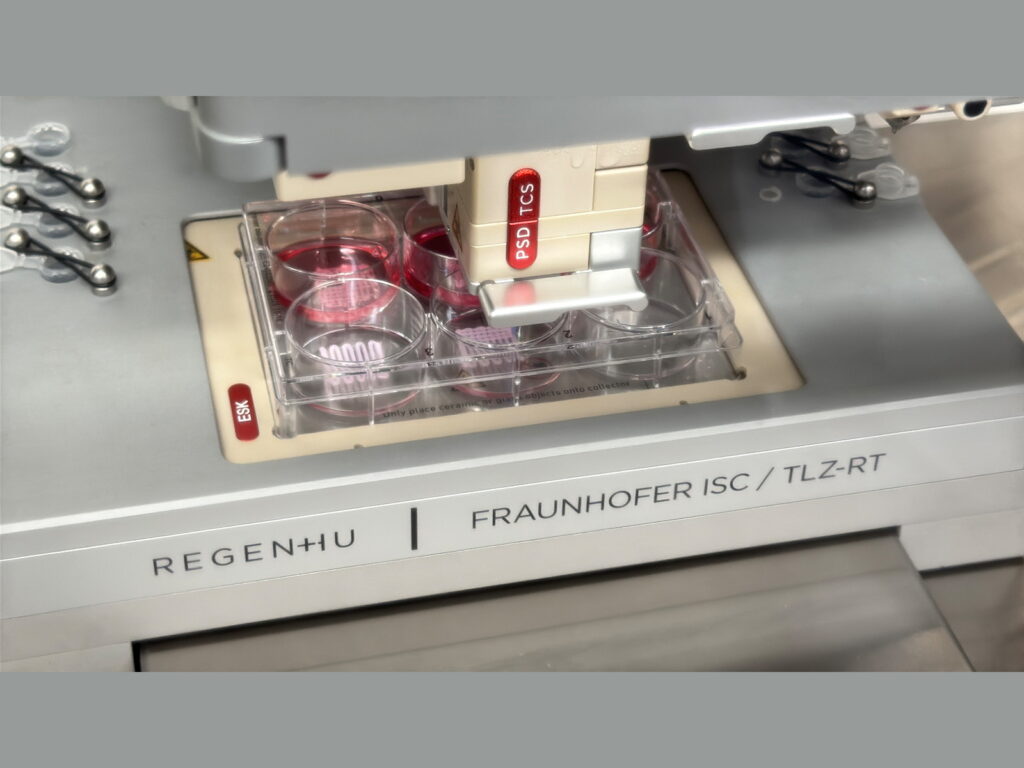
As part of the PhysioINK project, researchers at the Fraunhofer Institute are developing new “bioinks” made from collagen and elastin, the structural proteins that make up much of human tissue. The development of these “bioinks” involves solving several key challenges:
- Inks must be fluid enough to print.
- After printing, however, they must form a natural fibrous tissue structure again.
- At the same time, living cells embedded in the material must survive.
To address these challenges, scientists have developed a mechanism in which cellulose sulfate initially stabilizes collagen molecules, making them printable in the first place. A subsequent change in temperature then stimulates collagen to naturally self-organize.
Until now, this approach has apparently relied more on synthetic or chemically modified materials. The researchers involved in the PhysioINK project, however, use physiological material made up of proteins, the same type of material that makes up real organs.
Temperature, along with a slightly higher collagen content, plays a crucial role in keeping the organic ink stable and preventing it from gelling. One of the first successes was the production of 3D printed skin tissue models.
A C64 marked my entry into the world of PCs. I spent my student internship in the repair department of a computer shop and at the end of the day I was allowed to assemble my own 486 PC from “shop remnants”. I subsequently studied computer science at the Humboldt University of Berlin and also added psychology to my studies. After my first job as a research assistant at university, I went to London for a year and worked for Sega in quality control of computer game translation. This included work on games such as Sonic & All-Stars Racing Transformed and Company of Heroes. I have been writing for Notebookcheck since 2017.