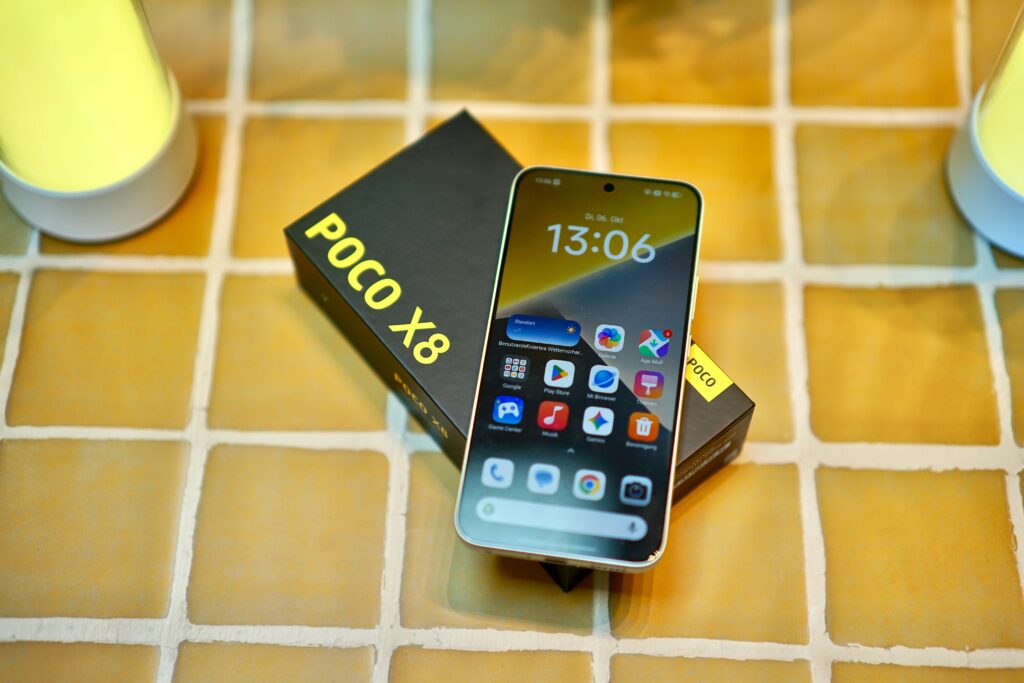
It’s no longer news that Xiaomi can pack great features into an affordable phone; the Chinese company has been doing this for years.
The AMOLED screen of this Xiaomi phone is exceptional
This year’s Poco X8, which costs around US$340, puts the spotlight on its very bright OLED screen, which reaches around 1,000 nits in daily use, making it suitable for outdoor use. In HDR mode and with small illuminated areas you can even reach 4,000 cd/m².
The 6.8-inch screen also offers a fast response time and balanced brightness distribution. However, two groups of users should take a closer look: First, there are sensitive people who have had bad experiences with PWM flickering in the past. They won’t necessarily be thrilled with the fairly low PWM frequency of 125 Hz. Although this is superimposed on DC dimming at over 3,000 Hz, you should definitely try the screen before purchasing if you’ve already had problems with this.
Even professionals who expect absolute color accuracy from their screen may be disappointed: color deviations peak at 6.86 DeltaE, which is a little too high, with reds in particular appearing too intense. For ordinary users, however, this is unlikely to make a difference in everyday use, especially since the color reproduction can be adjusted quite extensively to suit personal preferences.
The Poco X8 lasts forever
The second highlight of the Poco X8 is its huge battery, which offers a capacity of 8,340 mAh. This allows for a battery life of almost 30 hours in our Wi-Fi test. A similarly priced Motorola Moto G77 only gets up to 20 hours. The predecessor of the reviewed device, the Poco X7, offers more than 40 percent less battery life at 5.30 pm.
This means you can go days without charging your phone when you normally use your phone, and even with more demanding tasks, getting through a workday without a power outlet isn’t a problem.
And what do we have to criticize about the Xiaomi phone?
But we also found some things to criticize about the Xiaomi Poco X8. You can find out what they are and what final grade we give them in our in-depth review.
I initially wrote about gaming laptops when I joined Notebookcheck in 2009. I later took on the creation of the Notebookinfo comparison portal and worked with social media concepts for large companies such as BMW and Adidas, while I also returned to work for Notebookcheck in 2012. Today I focus on smartphones, tablets and future technologies. Since 2018, I have been the editor-in-chief for mobile device reviews, alongside my colleague Daniel Schmidt.