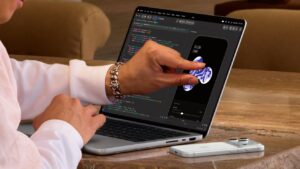
Artificial intelligence was used to figure out how to access motion tracking data from the AirPods, allowing a Linux user to use the head tracking data to produce a software mouse.
AirPods and AirPods Pro have head tracking capabilities thanks to some built-in motion detection sensors. While it’s currently used for things like spatial audio and Siri interactions, one enterprising user has taken steps to broaden its use on Linux.
Apple allows AirPods and other earbuds to run on Linux and other platforms by functioning as standard Bluetooth headphones. They can be used for normal listening, but things like head tracking aren’t available once you leave the Apple ecosystem.
In a post on Reddit on Friday, Matteo Guaduisi said he wanted to control his mouse using a pair of AirPods 3 on Linux. However, they said that every open source project in the same field said that AirPods 3 were not supported.
Artificial intelligence as hardware hackers
Spurred by this apparent lack of support, they spent an afternoon using Claude Code to find out how the AirPods 3 work when it comes to motion detection.
At one point, the AI agents were asked to check other similar projects in the background to find an answer. This turned out to be a good idea, as an agent discovered the answer in the iOS framework code.
It turns out that AirPods 3 uses a different protocol than the Pro models.
Additionally, data was not being sent due to using a restrictive default setting. The default maximum transmission unit (MTU) was too small for both standard audio data and motion sensor data, so the latter was excluded.
After fixing this, head tracking data was transmitted via Bluetooth at 200 Hz.
The effort eventually led to the creation of the MousePods project, which reads motion sensor data from AirPods 3 and AirPods Pro in Linux. As the name suggests, the user’s head movements translate into pointer movements on the desktop.
Crucially for AirPods users, the project relies on changes to the Linux host, not anything that directly affects the AirPods’ firmware. If you experience this, you won’t be left with non-working AirPods or anything that breaks a warranty.
The project has also released the code as “Open” and for others to use in their own projects.
Software but no broken AirPods
The project is interesting, as it shows how artificial intelligence is evolving in its use. We had the initial phase where AI wasn’t exactly an intelligent entity, then it got a little better, and then the beginning of the vibe coding era.
As the idea of using AI to handle challenging coding tasks has gained traction, attention has shifted to the impact on existing software. While games had mods that did the same thing relatively non-destructively, they are now used to address code more directly.
Not just people recreating Adobe products or hackers attacking systems. Some use AI to create new firmware for devices, such as cameras, completely changing the way they work.
To be clear, you should really check your device’s warranty before going this route. Depending on your warranty, it may not be acceptable to modify a device’s software beyond official firmware updates.
If it breaks when you ruin it, it’s your money down the drain.
An unusual application of AirPods emerged in July, after a developer turned them into a statistics-tracking Frisbee. After connecting an AirPod to a flying saucer, motion data can be sent to the Kinapod Disc app running on an iPhone, including rotation speed, total revolutions, and estimated release speed.
While in that case it was an application on Apple hardware, the Kinapod Disc app also preserved the usefulness of the AirPods without changing any firmware.
That said, the MousePods project is managed in such a way that it does not require any firmware updates. It’s a very non-destructive method of solving the problem and gives other developers an idea of how the technology works.
Even on platforms outside the Apple ecosystem.