As Apple’s new MacBook Pro with PROLED
These laptops, which sit above the already great MacBook Pro in Apple’s lineup, start at $2,899 for the 14-inch model. Opt for the 16-inch version and you’ll be handing over at least $3,399.
That’s hundreds of dollars more than their comparable MacBook Pro cousins. Keep in mind that these machines use the same M5 Pro and M5 Max chips. The same SSD and unified memory too.
Yes, I guarantee they are lighter and, sure, there have been some changes to the speakers and ventilation. But the real selling point is the PROLED XDR added to the laptop’s name.
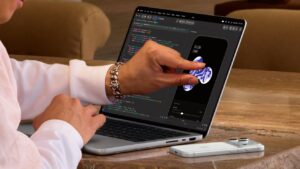
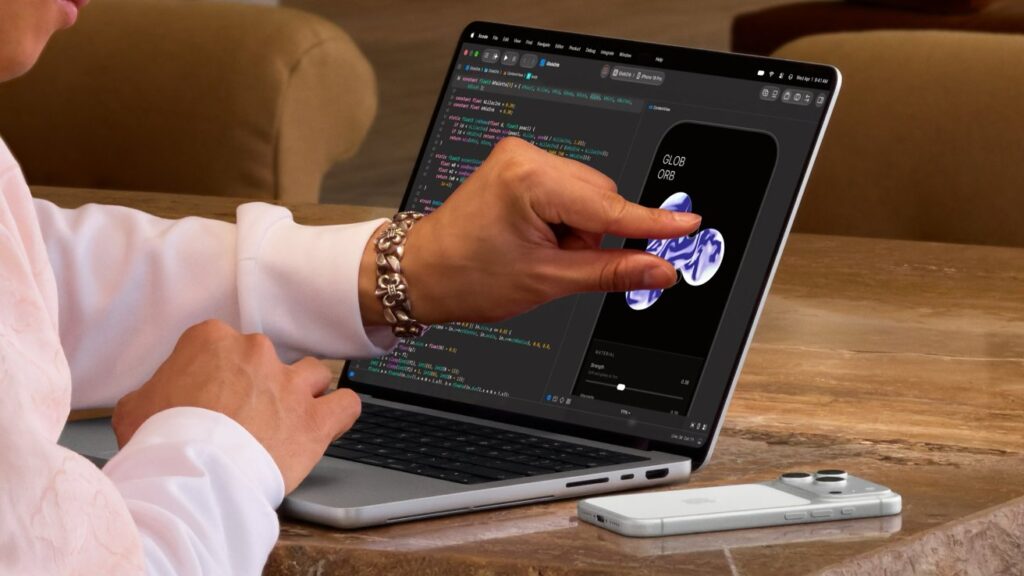
It is an OLED display, which brings with it its advantages. But the media event Apple held to show off these new laptops to influencers and YouTubers focused heavily on the touchscreen aspect.
This brings me back to wondering who, other than YouTubers and influencers, will buy this thing for touch over a vanilla MacBook Pro.
The marketing push
Apple’s marketing, including a very impressive YouTube ad, shows the MacBook Pro PROLED being used in the usual ways. We have videographers who work with videos and musicians who work with music.
This being 2026, there’s also an (un)healthy smattering of people doing AI-related things. Because these laptops are crazy good at this kind of thing.
These things are the staples of every Apple laptop announcement since the last, well, forever. But this time everyone is stabbing at the display as if someone stole their trackpad.
Smudges on the glorious OLED display
The idea is simple. OLED displays, with their 2,000 nit brightness and incredible color accuracy, make them perfect for creatives.
The fast M5 Pro and M5 Max chips are suitable for those working with multiple 4K and 8K video streams simultaneously. Huge amounts of RAM are exactly what those working with professional-level audio are clamoring for. These laptops are already ready for these people.
So, of course, they’ll also want to use their fingers to scroll through timelines. They’ll abandon keyboard shortcut-laden workflows and multitouch trackpad muscle memory to prod and poke at a display because, well, you reason.
That’s the theory, at least. I’m actually not convinced.
Ready for new customers
I’ve seen claims that Apple added touchscreen support to the Mac because that’s how kids use computers these days. Kids have spent the last decade and a half using iPads, swiping through apps with demonic precision.
The consensus is that, obviously, these kids will want a laptop they can touch. Any laptop they no longer own will be left behind, a relic to sit next to Macintosh and Pippin in museums.
This is an argument I can almost make myself. There’s a logic there, sure. Until you scratch the surface.
Apple may really want to capture up-and-coming kids and teens using CapCut to edit videos on an iPhone. But if it does, it’s using the wrong laptop to do it.
These guys aren’t going to buy $3,000 MacBook Pros, PROLED or otherwise. They’re buying a MacBook Neo or a MacBook Air. Maybe, with a simple push, a 14-inch M6 MacBook Pro.
Remember, we had touchscreens before OLED. Or PROLED, for that matter. Touch can be added to any MacBook Pro that Apple wants it added to.
But it wasn’t. It’s been added to an entirely new class of laptops that, in the midst of an affordability crisis, starts at nearly $3,000.
So, again, I’m not clear who the touch functionality is intended for.
I would say the two markets that everyone is talking about won’t want it or won’t be able to afford it.
Bright side
The good news is that the touchscreen aspect of the MacBook Pro PROLED can be ignored. It can also be turned off.
Unlike when Microsoft got very touchy with Windows 8 and broke everything, Apple’s macOS looks and works the same as before. If you stroke the screen with a meat stick, it will react. Otherwise it’s the same old macOS.
This brings its own problems, it’s true. Something as simple as closing a window means tapping traffic light controls that are too small, moving to where they just expanded, and tapping again.
This quirk extends elsewhere throughout the touchscreen experience. You need to long press to open menus, all while waving your hand at the display.
But it seems like once you’ve done it a couple of times out of curiosity, you’ll never have to do it again. You can also try it yourself now because it also works with external displays and iPads via Sidecar.
The good news keeps coming, because by all accounts, there’s a damn good MacBook Pro once you ignore everything else. Like other MacBook Pros, these things are lightning fast and quiet.
They also have the added benefit of OLED technology. Not that I’d seen anyone desperate for the backs of their mini-LED MacBook Pros before PROLED arrived.
Apple could have, maybe even should have, marketed the MacBook Pro PROLED as a new machine with an even better display. I think it should have waited until the M6 Pro and M6 Max arrived, through differentiation.
They probably didn’t do it, mostly for quarterly financial reasons.
For users we have an overly familiar laptop, identical in performance and extremely expensive. And the feature everyone focuses on is the one that all the reviews say people won’t use after the first day or two.
The MacBook Pro PROLED feels like a machine that didn’t need to ship when it did. It might be a more compelling option when the regular MacBook Pro isn’t lurking behind it in the lineup, but for now it seems impossible to recommend it to anyone but a vanishing minority.
And that’s not a good place for any new Apple product.