An intellectual property lawsuit over the Apple Watch’s Taptic Engine resulted in a loss for Apple, as a jury ruled that it owes Taction more than $5.7 billion for infringing patents.
Apple and many other device makers rely on haptic feedback to alert users that they have successfully pressed a button, as well as for message alerts and notifications. However, Apple’s implementation of this concept came at a very high legal cost.
In April 2021, Taction Technology sued Apple for allegedly infringing a pair of Taction patents, allegedly used in the Taptic Engine. Over five years later, Reuters reports that a jury has sided against Apple on the matter.
The verdict reveals that Taction managed to prove to the jury that Apple had infringed two claims in one patent and one in the other. However, on the second question, asking whether Taction had proven that Apple had intentionally infringed rights, the panel said no.
In fact, the jury says that Taction proved that Apple violated the rules, but not that Apple knowingly did so. This was not necessarily an intentional infringement on Apple’s part.
The third page of the form asks whether Apple had demonstrated that the three claims argued were invalid. Apple failed on all three counts.
The fourth part of the form, in which the jury determines the damages it believes Taction is owed by Apple, reports that Apple owes $5,721,961,750.
Following the result, Taction lawyer Lance Yang said the company was happy the jury had ruled in its favor and vindicated its patent rights.
Apple, meanwhile, insists it doesn’t infringe on Taction’s technology. Furthermore, he claims that Taction is not entitled to any damages and that the damages are not based on any evidence in the court record.
Apple also said it disagreed with the verdict and would appeal.
Apple’s statement, shared with AppleInsiderstates:
While we thank the jury for their consideration, we strongly disagree with today’s verdict and the damages awarded, which are not fully supported by the facts. Apple’s Taptic Engine is fundamentally different from Taction’s technology, as confirmed by Taction’s testing of Apple products in the trial. Apple does not use Taction technology and we will appeal.
A brief legal history
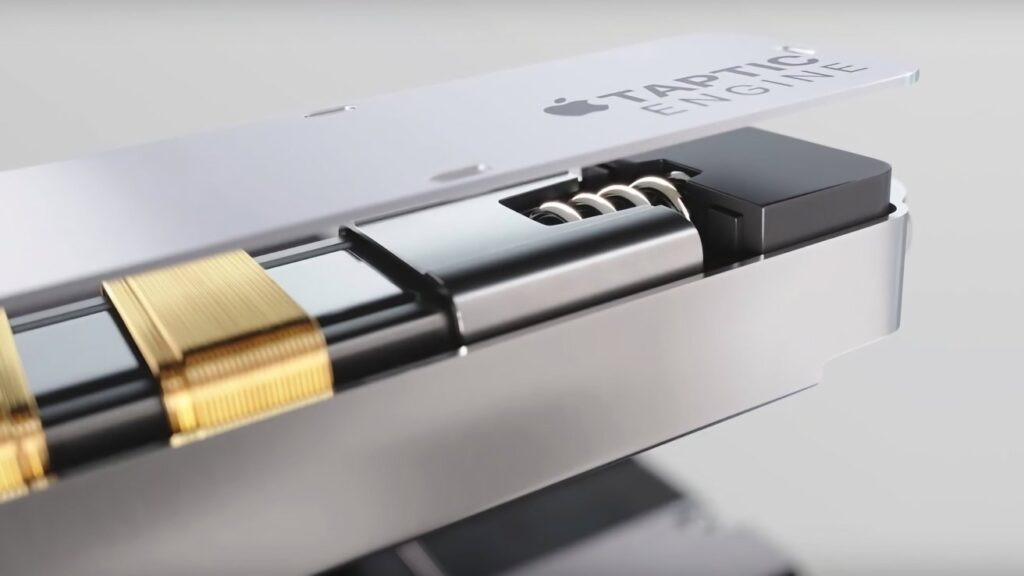
Apple introduced the Taptic Engine with the Apple Watch in 2014, as a new type of haptic feedback system that used a linear resonant actuator instead of vibrating motors. The change meant there was a lot of control over the moving mass, allowing for tactile experiences ranging from buzzing and tapping to simulating a heartbeat.
It was such a success that the concept was incorporated into other products, including the iPhone.
In 2021, Taction sued Apple, claiming that Apple initially used coil springs to provide controlled resistance to Taptic’s moving mass, complete with a central locating rod. Newer designs use push-ups with ferrofluid to localize mass and provide controlled resistance.
Apple was accused of purchasing and reverse engineering two Kannon earphones that used the technology.
A federal judge in San Diego ruled in 2023 that Apple did not infringe the patents. However, the US Court of Appeals for the Federal Circuit revived the case in 2025.
Updated September 26, 2026 at 1:00 pm ET: Added Apple statement.