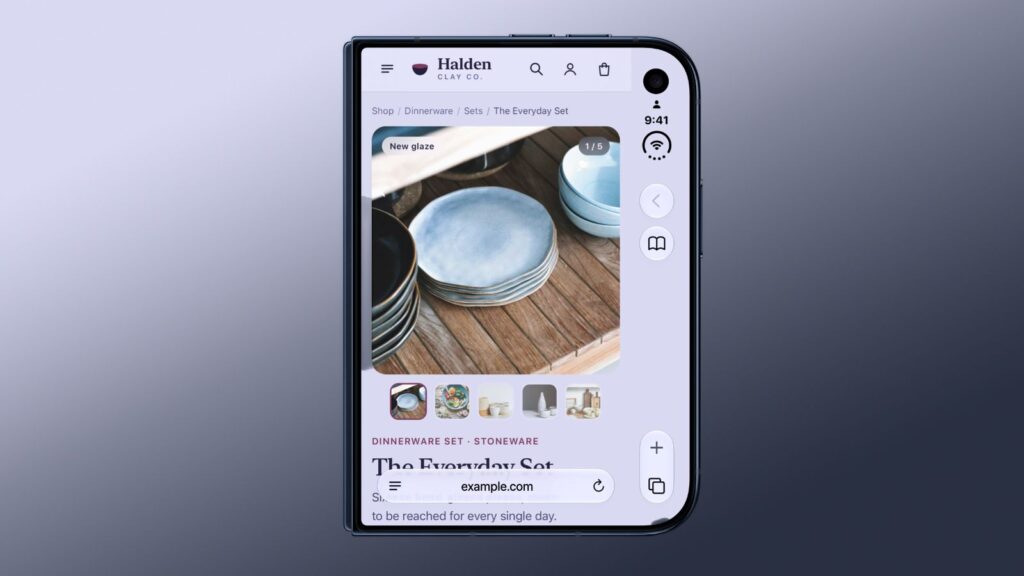
Apple is considering changes to Safari on the iPhone Duo that would give websites access to more of the external display, though the company has yet to decide on an approach.
The challenge is to allow pages to occupy the area under Safari’s side controls without making parts of a website inaccessible. In a WebKit post on Friday, Oct. 23, Apple’s Jen Simmons explained that an existing web setup could allow this, but Apple’s research suggests that many sites wouldn’t handle it properly.
This setting, viewport-fit=”cover”, allows a web page to expand into areas that would otherwise be restricted. Website developers must therefore leave enough space around important content to prevent it from being covered by the interface. According to Simmons, many sites fail to meet these limits on all edges.
Apple is evaluating whether another solution could give developers more control with less risk of obscuring content. The background of a header might, for example, extend across the screen while its navigation links remain within the unobstructed portion.
For now, Safari 27.1 limits web pages to the area next to controls and uses the page’s background color to fill the remaining stripe. This limits the width available for content on the external display.
The layout comes from the aspect ratio of the screen. Apple placed the controls along the side of the device because the external display is shorter and wider than other iPhone screens, preserving more height for apps and web pages.
Separately, Safari 27.1 adds automatic viewing of two-page PDFs when the iPhone Duo is held partially folded like a book. Flattening or closing the device returns the document to single-page view.
Developers can also test experimental support for detecting the screen fold position and positioning content around the center fold of the device. Those features are available behind Safari feature flags, while the proposed change to the content under the controls remains under investigation.